
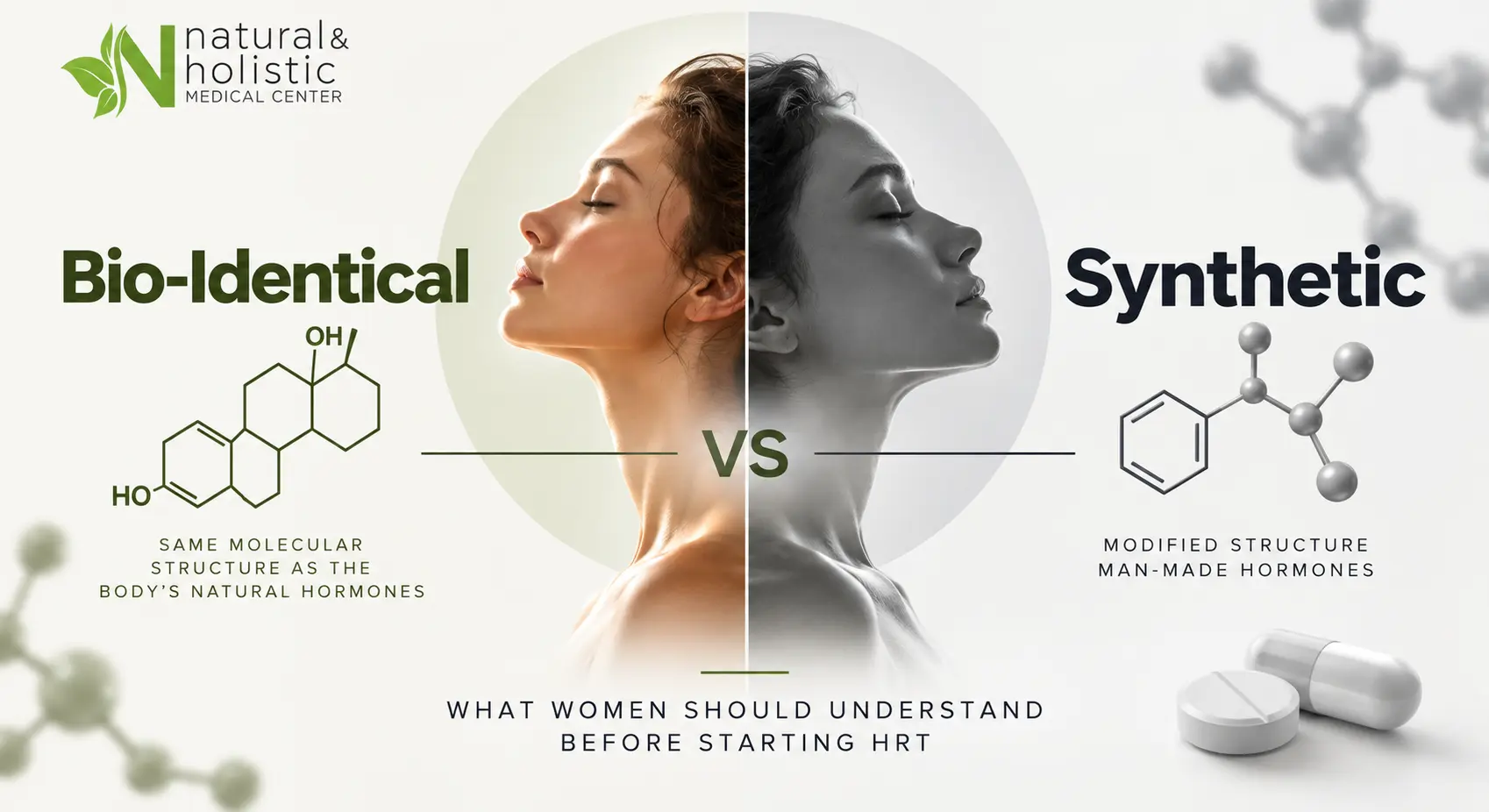
If you have decided that hormone replacement therapy may be right for you, the next question is often the most confusing: bio-identical or synthetic? The terms get used interchangeably in some places and treated as opposites in others. The marketing around them is intense on both sides.
Here is the direct answer: bio-identical hormones have the same molecular structure as the hormones your body naturally produces. Synthetic hormones do not – their molecular structure is different, though they are designed to produce similar effects. That single distinction has meaningful implications for how these hormones behave in the body, how they are metabolized, and what side effect profile you may experience.
Below is a straightforward, evidence-based look at what the difference actually means, what the research shows, and what to consider before starting either.
What “Bio-Identical” Actually Means
Both bio-identical and synthetic hormones are manufactured in a laboratory. The term “bio-identical” refers to molecular structure, not source. A bio-identical hormone is one whose chemical structure exactly matches the estrogen, progesterone, or testosterone your body produces naturally. A synthetic hormone has a different molecular structure – it is designed to activate similar receptors, but the molecule itself is not what your body would make on its own.
Common examples: estradiol and micronized progesterone are bio-identical hormones. Conjugated equine estrogens (CEE, sold as Premarin) and medroxyprogesterone acetate (MPA, sold as Provera) are synthetic hormones with different molecular structures than what the human body produces (source: MGH Center for Women’s Mental Health, citing FDA guidance).
The reason this distinction matters is that the body’s enzymes, receptors, and metabolism have evolved to interact with the exact structures your body produces. When a molecule is even slightly different, it can be broken down differently, produce different downstream effects, or activate secondary pathways your natural hormones would not.
The Women’s Health Initiative and Why HRT Was Feared for Years
Much of the current conversation about HRT safety traces back to the Women’s Health Initiative (WHI), a landmark study launched in 1992. The WHI examined the effects of hormone therapy on postmenopausal women, and in 2002, it reported increased risks of breast cancer, stroke, and blood clots in women taking a specific combination of synthetic hormones – conjugated equine estrogens (CEE) plus medroxyprogesterone acetate (MPA).
This finding led to a dramatic decline in HRT prescriptions and years of widespread caution about hormone therapy in general (source: PMC study comparing CEE/MPA to bioidentical hormone therapy).
What is often missed in the popular retelling: the WHI studied specific synthetic formulations, not all hormone therapy. Subsequent research has suggested that the risks identified may be specific to those synthetic formulations rather than to hormone therapy as a category (source: Paloma Health clinical review of HRT research; NRG Clinic evidence review). This is why the bio-identical vs synthetic distinction matters clinically – the safety profile of one is not automatically the safety profile of the other.
What the Research Suggests About Safety Differences
Current evidence suggests bio-identical hormones – particularly transdermal estradiol (delivered via patch or gel) and micronized progesterone – may have a more favorable safety profile than the older synthetic formulations studied in the WHI.
Specifically, research indicates that transdermal bio-identical estradiol is associated with a lower risk of blood clots than oral estrogen, especially in women at higher cardiovascular risk (source: multiple clinical reviews including Paloma Health, RVAOHW). This is thought to be because transdermal delivery bypasses first-pass liver metabolism, which reduces the impact on clotting factors.
Observational studies have also suggested that bio-identical progesterone may be associated with different breast cancer risk profiles than synthetic progestins like MPA, though more long-term randomized trials are needed to draw firm conclusions (source: PMC comparative studies).
It is worth being clear: bio-identical is not automatically safer for every woman. Individual health history, delivery method, dose, and monitoring all matter significantly. The evidence points to a more favorable safety profile on average, particularly for transdermal estradiol and micronized progesterone – not a blanket safety guarantee for all bio-identical formulations.
FDA-Approved vs Compounded Bio-Identical Hormones
This is where the conversation gets more nuanced. Not all bio-identical hormones are FDA-approved, and this distinction matters.
FDA-approved bio-identical hormones include estradiol patches, gels, and tablets, as well as bio-identical micronized progesterone capsules (sold under brand names like Prometrium). These have been evaluated by the FDA for quality, potency, and consistency.
Compounded bio-identical hormones are custom-mixed formulations prepared by compounding pharmacies based on a provider’s prescription. The individual hormones themselves may be FDA-approved as ingredients, but the custom-mixed formulation is not FDA-regulated (source: MGH Center for Women’s Mental Health, FDA guidance). Reputable compounding pharmacies follow United States Pharmacopeial Convention (USP) compounding standards, but quality can vary significantly between pharmacies.
The takeaway: compounded bio-identical hormones can be an appropriate option in certain situations – for example, when a specific dose or combination is needed that is not available in a standard FDA-approved product – but they should always be sourced through a supervising licensed medical provider using a reputable compounding pharmacy.
How to Think About the Choice
The right hormone therapy is the one that fits your individual health profile – not the one that is trending. A thoughtful provider will consider your medical history and family history, symptom profile and severity, cardiovascular risk factors, breast health history, delivery method preferences, and how your body responds over time.
For many women, FDA-approved bio-identical options like transdermal estradiol paired with micronized progesterone provide the benefits of hormone therapy with a favorable safety profile. For others, compounded formulations may be appropriate. For some, synthetic options may still be the right fit based on individual circumstances.
At Natural and Holistic Medical Center, our licensed naturopathic doctors take the time to evaluate your labs, health history, and goals before recommending any hormone therapy plan. We discuss both bio-identical and synthetic options openly, explain what current evidence supports for your specific situation, and design a personalized plan with clear follow-up and monitoring.
Ready to Understand Your Options?
If you have been considering hormone replacement therapy and want a provider who explains your options thoroughly – not one who pushes a single approach – our East Valley team is here to help. Serving Mesa, Gilbert, Chandler, Tempe, and the greater Phoenix area, we support women through hormonal transitions with individualized, evidence-informed care.
Call now to schedule your consultation with our licensed naturopathic doctors.
Not exactly. Bio-identical hormones are manufactured in a laboratory, just like synthetic hormones. What makes them “bio-identical” is that their molecular structure matches the hormones your body naturally produces. The source materials are often plant-derived (from soy or wild yam), but they are converted into hormones through laboratory processes.
Some are, some are not. FDA-approved bio-identical options include estradiol patches, gels, and tablets, as well as bio-identical micronized progesterone. Compounded bio-identical hormones – custom-mixed formulations prepared by pharmacies – are not FDA-regulated as final products, though the individual ingredients often are (source: MGH Center for Women’s Mental Health, FDA guidance).
Current evidence suggests bio-identical hormones – particularly transdermal estradiol and micronized progesterone – may have a more favorable safety profile than the older synthetic formulations studied in the Women’s Health Initiative. However, “safer” depends heavily on the individual’s health history, the delivery method, and appropriate monitoring. Bio-identical is not automatically safer for every woman.
Research suggests that transdermal estradiol (patches or gels) is associated with a lower risk of blood clots than oral estrogen because it bypasses first-pass liver metabolism. This may be particularly relevant for women at higher cardiovascular risk. However, the right delivery method depends on individual factors and should be discussed with your provider.
Yes, in many cases – but this transition should always be managed by your prescribing provider. Different hormone types require different dosing, and abrupt switches can produce unwanted symptoms. A thoughtful transition plan includes lab monitoring and dose adjustments as your body adapts.
Much of the conflicting information stems from misinterpretation of the Women’s Health Initiative (WHI) study, which examined specific synthetic hormone formulations but was often reported as evidence that “all HRT is dangerous.” Subsequent research has refined that picture significantly. For accurate guidance specific to your situation, work with a provider who can explain the current evidence in the context of your individual health profile.